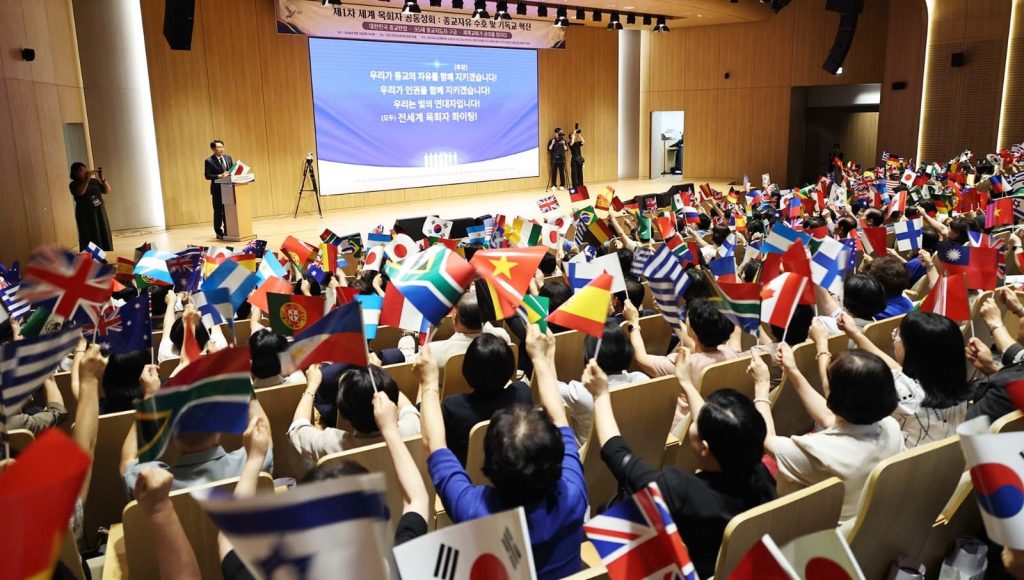
Five religious organizations — the Korean Christian Coexistence Council, the Korea Christian Leaders’ Training Institute, the Pastors’ Alliance for the Protection of Life and Human Rights, the Russian
Evangelical Alliance, and the Thailand Evangelical Fellowship — held the “1st World Pastors’ Joint
Revival Meeting” on the 13th, sharply criticizing what they described as serious violations of religious
freedom and the erosion of the principle of separation of church and state currently occurring in
South Korea. About 2,000 pastors from major countries around the world attended the meeting online and in
person. Speakers presented specific cases of administrative, tax, and judicial suppression of religion
said to be occurring across South Korean society generally, not limited to any single organization or
denomination, drawing concern from the international community. “From taxing mission support funds to the corporate dissolution law — institutional suppression
that ties the church’s hands” Speakers at the meeting pointed out that various institutional and financial pressure measures
currently being pursued or applied by the South Korean government and political circles are stifling
the church’s pure activities of faith and mission. Particular criticism was directed at tax authorities’ practice of arbitrarily imposing gift tax on mission
support funds that churches send abroad for missionary purposes, and at discussions of a “Religious
Corporation Dissolution Law” that would open the way for the state to forcibly dissolve religious
organizations it disfavors. Kim Geon, head of the Yeongnam Presbytery of the Tonghap General Assembly of the Presbyterian
Church of Korea, criticized the tax as “an unjust state intrusion into the church’s essential activity of
gospel proclamation and a financial strangulation operation,” adding that pursuit of the religious
corporation dissolution law was “a dangerous idea that the state could decide the survival of any
denomination or church at any time in the name of law — a blade aimed at others today will be
aimed at every church tomorrow.” Pastor Lim Young-woong of the Presbyterian Church of Korea also warned that “discussion of
dissolving the religious corporation status of a particular denomination is not a problem for that one
denomination or country alone,” and that it is “a dangerous signal that all of our faith and religious
freedom could be stripped away by state power at any time.”
“Pastor Son Hyun-bo, Han Hak-ja, Lee Man-hee — successive detentions of leaders amount to trial
by public opinion”
Participants also expressed strong concern over what they called excessive detention investigations
and judicial pressure being applied to major religious leaders regardless of denomination. They condemned the successive detentions or indictments of major religious leaders — including
Pastor Son Hyun-bo (Segyero Church), who was recently detained after speaking out on social issues
and policy, along with Unification Church leader Han Hak-ja and Shincheonji General Chairman Lee
Man-hee — as “a result of the collapse of the constitutional presumption of innocence and the
criminal procedure principle of investigation without detention.” Pastor Lee Dong-geun of the Baekseok Daeshin International Presbytery said that “detentions are
being carried out excessively, driven by public ‘social disfavor’ and ‘pressure of public opinion’ rather
than by guarantees of a fair defense or objective evidence,” adding that “the excessive abuse of
judicial power — including the detention of a 95-year-old veteran and highly decorated leader —
that abandons even basic humanitarian standards is a clear violation of human rights.” Anglican priest Heo Jong-hyun likewise stressed that “public and mob anger must not become the
standard for judicial rulings,” and that “witch-hunt-style trials driven by political calculation and
public pressure rather than law and principle must stop immediately.”
“We will unite to restore the separation of church and state and defend universal religious
freedom” Presbytery head Kim Geon said that “separation of church and state is a democratic bulwark that
protects against state power improperly intervening in the domain of religion,” and that “for the
state to investigate a religion’s internal activities and doctrine, or to pressure it through targeted tax
audits or forced dissolution, is to deny the spirit of the South Korean Constitution itself.” The final speaker, Pastor Rugagi Innocent of an evangelical church in Rwanda, Africa, said that “our
African churches, too, have painfully experienced the tragedy that follows when state power tries to
control the realm of faith,” and declared that “since true faith knows no borders, churches worldwide
will strongly unite, transcending denomination and nationality, for the restoration of religious
freedom in South Korea.” The meeting concluded with the announcement of a joint statement adopted with the signatures of
some 2,000 pastors from around the world. The statement called for: an end to religiously biased
suppression by the government and political circles; an end to trial by public opinion in the judiciary
and adherence to the presumption of innocence; and bail and immediate release for elderly religious
leaders. The organizers of the joint revival meeting stated, “The cases presented here are not the problem of
any single denomination, but a grave warning signal concerning religious freedom in South Korea as
a whole,” and added that they “will continue to respond in solidarity with international human rights
organizations and churches worldwide until the government and judicial authorities return to the
principles of fair justice and separation of church and state.”
![Daredevil 1b copy[96]](https://stokveltalk.co.za/wp-content/uploads/2026/10/Daredevil-1b-copy96-250x300.jpg)