
THR Global contributor urges Treasury to examine whether taxing liquid volume unintentionally drives adults to higher
nicotine consumption, and is counter-intuitive to adults who are trying to quit smoking.
South Africa’s e-liquid tax could be creating a financial incentive for adults to choose higher nicotine
concentrated products, according to consumer advocate and THR Global founder Kurt Yeo, who is calling for
an independent review of the duty’s design.
Yeo, the founder of THR Global, argues that the tax should be assessed against its effects on purchasing
decisions and smoking outcomes. He is urging National Treasury to investigate whether the current structure
supports adults attempting to move away from combustible cigarettes.
The concern centres on how the levy is calculated. According to SARS guidance, the duty is based on the volume
of e-liquid produced, measured in millilitres. Under a flat charge per millilitre, a smaller volume containing
more concentrated nicotine can attract less excise than a larger volume containing the same total amount of
nicotine.
A hypothetical comparison illustrates the issue. A 10ml bottle at 18mg/ml and a 30ml bottle at 6mg/ml each
contain 180mg of nicotine. The larger bottle attracts three times as much excise under a flat charge per
millilitre, despite containing the same total quantity of nicotine.
Yeo argues that this difference warrants investigation into whether the tax creates an incentive towards
stronger products. The calculation alone, however, does not establish that consumers change their purchases,
absorb more nicotine or return to cigarettes. Retail prices also reflect manufacturing costs and commercial
decisions, while nicotine intake depends on how a product is used.
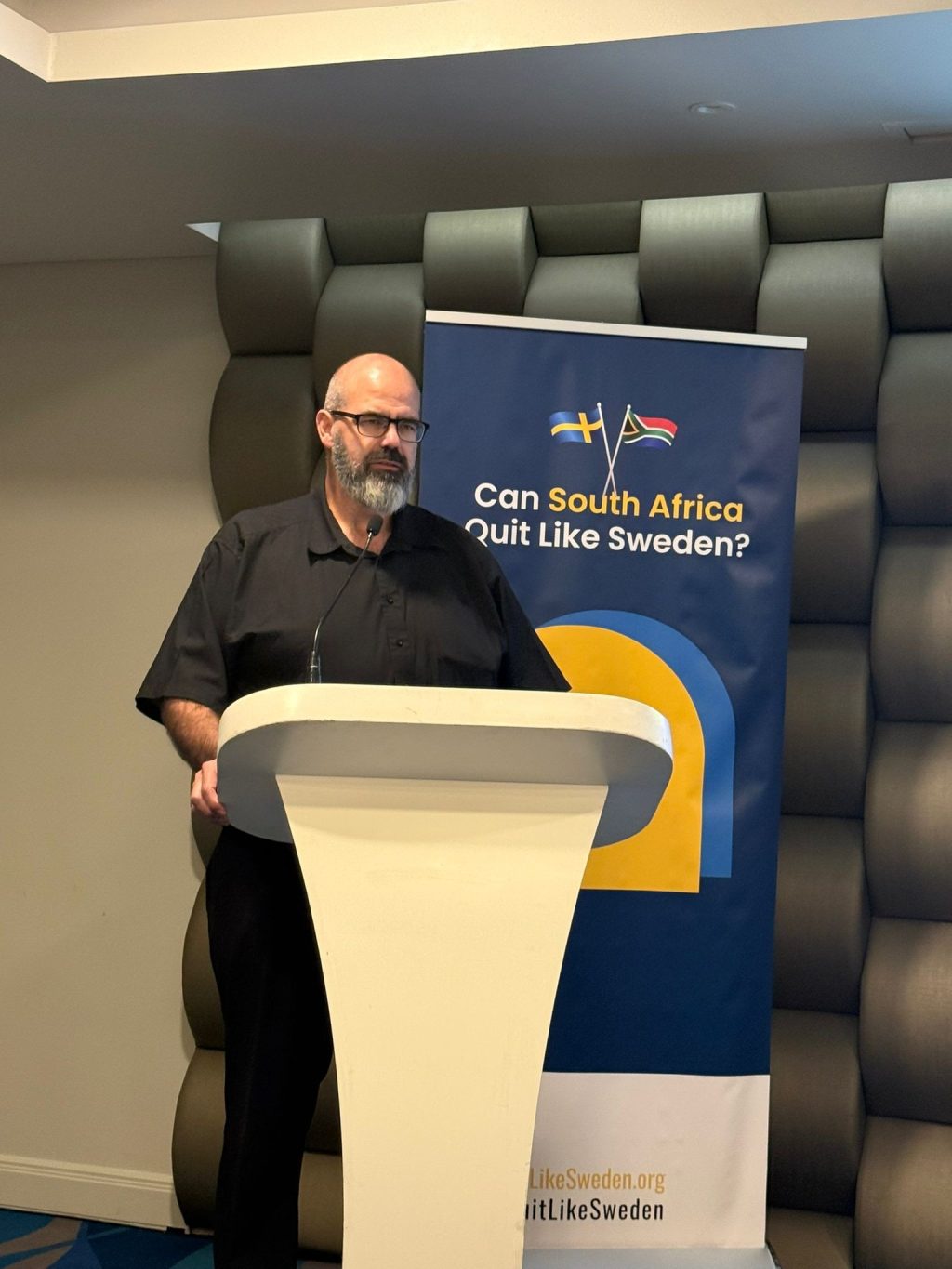
Yeo represented THR Global at Parliament’s Standing Committee on Finance public hearings on 8 October
2024, where the organisation presented on proposed revenue legislation. The review he advocates would
examine the practical consequences of the tax structure.
The call sits within a wider debate about how smoking cessation evidence should inform policy. Cochrane’s
living review, updated in August 2026, finds high-certainty evidence that nicotine e-cigarettes increase smoking
quit rates compared with nicotine replacement therapy, such as patches or gum. The researchers also identify
remaining uncertainties about adverse effects and the need for longer, larger studies to assess safety.
Those findings concern smoking cessation and do not establish whether South Africa’s e-liquid tax helps or
hinders quitting. Yeo’s proposal is for local research connecting tax design, product choice and smoking
outcomes, rather than treating international clinical findings as proof of a domestic tax effect.
Health risks also remain central to the discussion. The NHS states that vaping is not risk-free, nicotine is highly
addictive and the long-term effects of vaping remain uncertain. It advises children and non-smokers against
vaping and stresses that adults switching from cigarettes need to stop smoking completely to obtain the full
benefits.
Consumer testimony provides a further perspective. THR Global currently records 262 participant-reported
experiences from 33 countries, documenting individual journeys away from smoking. The platform gives
participants a way to describe what they tried, what changed and which obstacles they encountered.
Its methodology explicitly identifies the accounts as a self-selected sample rather than population data. They
cannot establish national quit rates, comparative product safety or the effects of taxation. Their contribution
is to identify experiences and questions that researchers can examine alongside clinical and population
evidence.
Yeo argues that this detail matters because a tax schedule cannot show how an adult manages the cost of a
quit attempt or why a particular approach becomes difficult to sustain. Consumer participation could help
researchers identify the practical decisions that deserve closer study.
The proposed review would examine retail prices, purchasing patterns and cigarette use, including whether
adults change nicotine strength or liquid consumption in response to the duty. It would also assess youth
uptake and distinguish the influence of tax from changes in products, marketing and household finances.
A tax component linked to nicotine content could be among the options assessed, Yeo proposes. Any
alternative would need to be tested against the current structure, with attention to enforcement and
unintended effects. Lower nicotine concentration, lower total nicotine consumption and stopping smoking
would need to be measured separately.
He is also calling for transparent recruitment and disclosure of relevant interests in consumer research. That
would include hearing from adults whose attempts failed or who returned to cigarettes, so that the assessment
captures where support falls short.
Yeo’s central recommendation is for Treasury to commission and publish an independent assessment of the
duty’s effects, providing an evidence base for deciding whether the current design should change.