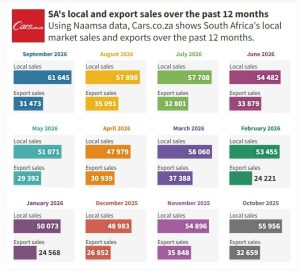
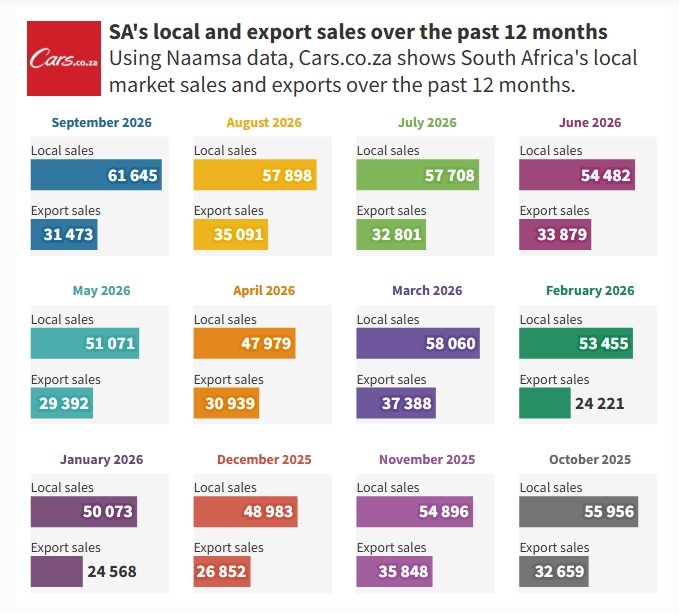
September 2026 delivered the strongest monthly sales result the South African new-vehicle market has seen in years. With 61,645 units sold—a 12.7% increase over last year—the industry has now notched up two full years of uninterrupted growth.
Industry data from Naamsa shows that September’s total not only surpassed the previous 2026 peak set in March but also pushed the market past the 60,000-unit threshold for the first time in several years.
Alan Quinn, Chief Innovation and Product Officer at Cars.co.za, stated that “in September 2026 the new-vehicle market in South Africa surpassed the 60 000-unit mark and achieved its 24th month in a row of year-on-year growth. This achievement shows how strong local demand has remained even in the face of continuing economic difficulties, consumer preference shifting more and more to affordability and value in all vehicle segments.”
Toyota leads historic surge
Toyota South Africa Motors, including Lexus and Hino, broke through the 15,000-unit barrier for the first time since March 2022. With 15,366 units sold, Toyota claimed a commanding 24.9% share of the market.
Toyota’s September performance represented an 11.2% jump over the previous month, reinforcing its position as South Africa’s clear market leader.
Top 10 best-selling automakers – September 2026
| Position | Brand | Units Sold | Month-on-Month Change |
| 1 | Toyota | 15 366 | +11.2% |
| 2 | Suzuki | 6 668 | +2.5% |
| 3 | Volkswagen Group | 5 968 | +5.3% |
| 4 | Ford | 3 190 | -0.4% |
| 5 | Hyundai | 3 057 | +0.8% |
| 6 | Isuzu | 3 022 | +19.4% |
| 7 | Chery | 3 004 | +8.7% |
| 8 | GWM | 2 700 | +4.1% |
| 9 | Jetour | 2 036 | +4.3% |
| 10 | Kia | 1 840 | +3.2% |
Key market movements
Suzuki posted its best sales of 2026 to date, moving 6,668 units and holding onto second place. Isuzu, meanwhile, grew its sales by 19.4% month-on-month to 3,022 units, overtaking both Chery and GWM to secure sixth spot.
Chery crossed the 3,000-unit mark for the first time, registering 3,004 vehicles, although it slipped to seventh place overall.
Ford held onto fourth place with 3,190 units sold, while Hyundai remained in fifth with 3,057 units.
Export sales, however, fell 18.8% year-on-year to 31,473 units, as global supply chain and demand pressures continued to weigh on the industry.
Segment breakdown
Passenger vehicle sales climbed 14.7% year-on-year to 44,291 units, with rental fleets accounting for roughly 18.4% of that total.
Light-commercial vehicle (LCV) registrations also grew, up 9.6% over last year to 14,361 units.
Industry outlook
Brandon Cohen, who chairs the National Automobile Dealers’ Association (NADA), called the September figures “encouraging”, pointing out that the stronger performance in the third quarter had provided dealers and manufacturers with a “positive foundation” for the last part of the year.
Cohen pointed out that the key now is to align available vehicles and finance options with what customers genuinely want and can afford.
Thanda Sithole, Senior Economist at FNB and WesBank, highlighted that demand remained resilient despite higher borrowing costs and renewed pressure from fuel and living expenses.
Naamsa cautioned that the macro-economic environment has become tougher in recent months, as rising energy costs have squeezed household budgets. Even so, the organisation credits the market’s resilience to a more competitive and diverse industry structure.