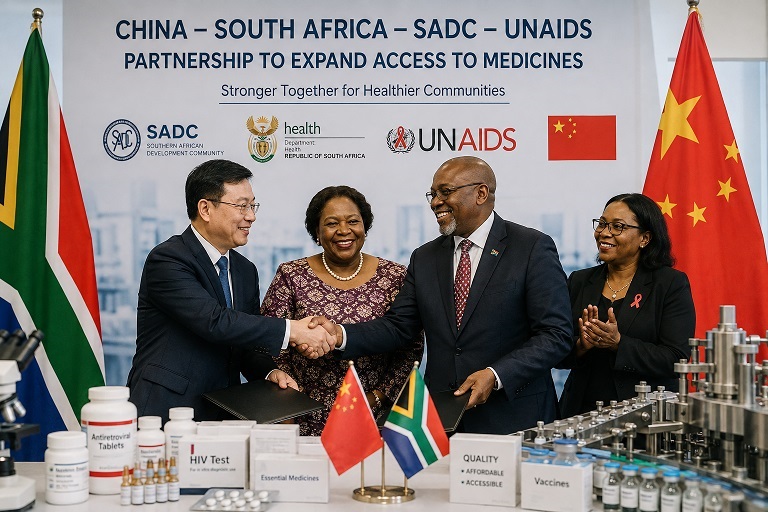
China, South Africa and regional and international health partners are strengthening cooperation to expand access
to medicines and build a more resilient pharmaceutical sector across Southern Africa.
The initiative brings together the South African and Chinese governments, the Southern African Development
Community (SADC), UNAIDS, the Global Health Innovation Institute (GHII), pharmaceutical companies, research
institutions and development partners.
The collaboration is aimed at strengthening local pharmaceutical manufacturing, encouraging technology transfer
and improving the availability of essential medicines, diagnostics and other health products across the region.
The partnership was advanced through a SADC-China strategic exchange held from August 31 to September 4,
with engagements taking place in Johannesburg, Durban and Cape Town. The programme included discussions
with government and regulatory officials, pharmaceutical manufacturers, researchers and other stakeholders.
According to UNAIDS, the initiative draws lessons from the global HIV response and seeks to develop stronger
partnerships that can help African countries increase their capacity to produce medicines locally.
UNAIDS Regional Director for East and Southern Africa Anne Githuku-Shongwe said stronger pharmaceutical
manufacturing was about more than simply producing medicines.
She said it could give African countries greater control over the health products their populations depend on, while
creating opportunities for skills development, investment, technology transfer and stronger health systems.
The collaboration comes at a time when countries across Africa are increasingly focused on health security and the
need for reliable supply chains for essential medicines.
For Southern Africa, developing regional manufacturing capacity could reduce vulnerability to international supply
disruptions while supporting economic development and creating opportunities for innovation.
SADC Secretariat representative Dr Lamboly Kumboneki said health security required countries to have the
capacity to produce essential health products. He said cooperation with China could help connect African
manufacturing capabilities with investment, technology and expertise.
A key area of the partnership will be exploring how Chinese investment and pharmaceutical expertise can support
the development of manufacturing capabilities in Africa. Discussions will also focus on improving market
intelligence, demand planning, regulatory preparedness and pooled procurement.
The latest initiative builds on existing health cooperation between China and South Africa. In January 2026, South
Africa’s National AIDS Council announced that China had pledged US$3.49 million, approximately R60 million, to
strengthen HIV prevention services in the country over two years. The funding, facilitated through UNAIDS, targets
young people and people who inject drugs.
Chinese Ambassador to South Africa Wu Peng has previously stressed China’s commitment to supporting South
Africa’s HIV prevention and treatment programmes, including through policy dialogue, innovative drug supply,
technology transfer and capacity building.
The new pharmaceutical manufacturing partnership therefore represents a broader approach to health cooperation,
moving beyond access to medicines towards building the capacity to manufacture them.
Stakeholders believe that stronger Africa-China cooperation could contribute to a more sustainable health system
in Southern Africa, while opening opportunities for local pharmaceutical companies, researchers and skilled
workers.
At the conclusion of the strategic exchange, participating partners identified priority areas and practical next steps
for strengthening pharmaceutical manufacturing and health commodity security across the region.
The long-term goal is to ensure that people in Southern Africa have more reliable and sustainable access to
essential medicines while countries develop greater control over their health security.